Affordability-first discovery
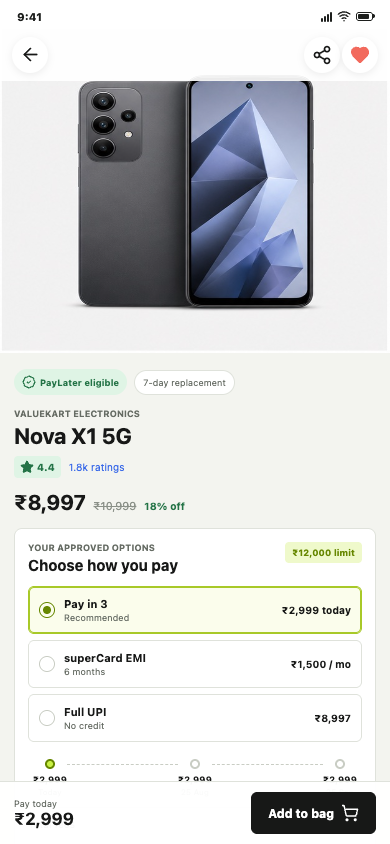
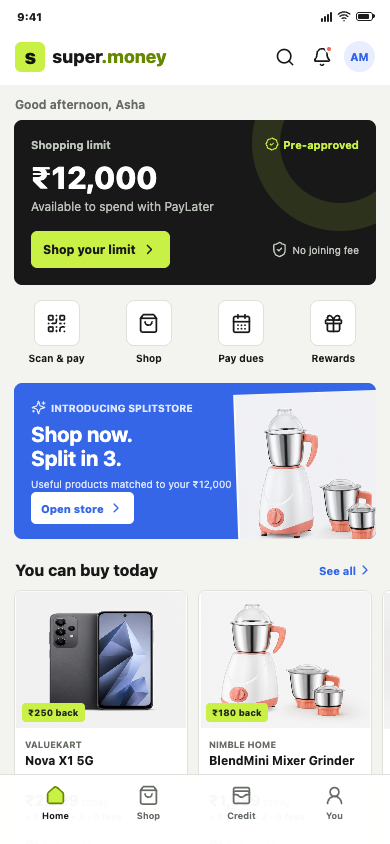
Rank financeable products by the amount due today and the user’s available shopping limit.
Primary signalQualified PDP-to-bag conversion
Designing an affordability layer that connects UPI frequency, transparent credit checkout, a narrow product catalogue, and a seller operating system.
01 · Brief
super.money already has high-frequency UPI usage, Credit Health, credit access, and a Splitstore entry. The product question is how to turn those assets into a commerce habit without becoming a broad inventory or logistics business.
How could super.money build a repeatable, contribution-positive commerce business by helping eligible users discover what fits their cash flow?
02 · Scope
The first release targets one purchase job and three low-complexity category groups. Credit is one affordability instrument; eligible customers can still choose full UPI.
Rank financeable products by the amount due today and the user’s available shopping limit.
Show repayment deltas, remaining limit, total payable, lender, KFS, and consent before confirmation.
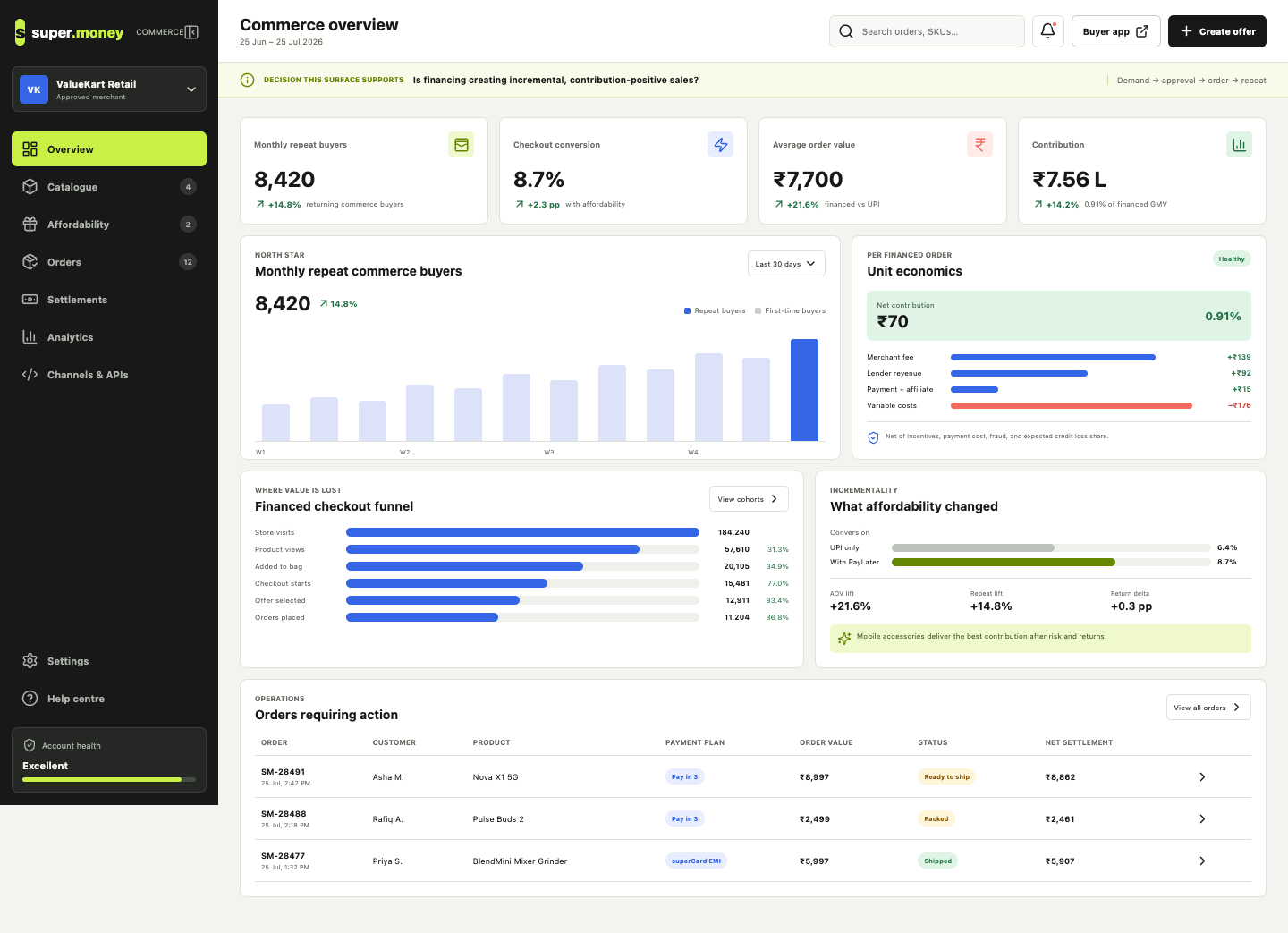
Unify catalogue controls, funded offers, orders, settlements, analytics, and merchant APIs.
03 · Product experience
Switch between the borrower and seller surfaces. Each state shows the problem, decision, and metric it exists to move.
Credit Health
Credit Health remains a standalone borrower capability. Viewing a score never starts an application, and a score never promises eligibility.
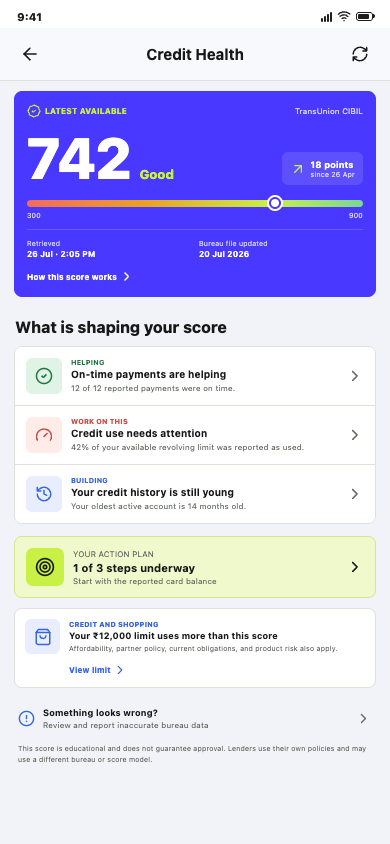
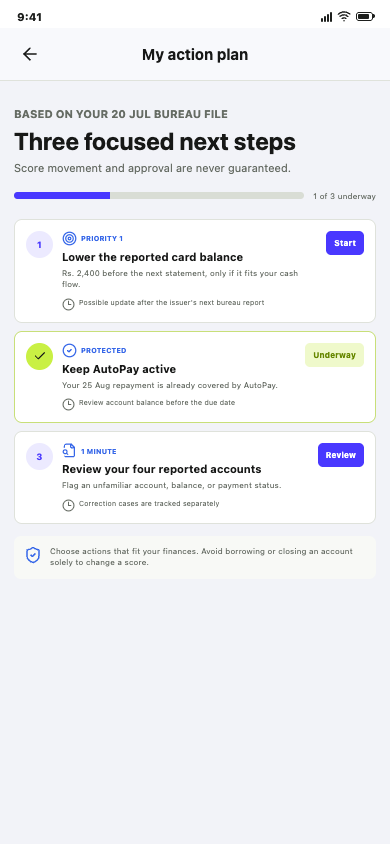
Show bureau, model range, retrieval time, and source-file freshness after purpose-specific consent.
Translate verified reason codes into positive, limiting, and potentially inaccurate factors.
Prioritize three safe actions with honest time horizons and track corrections through a visible case.
Preserve the dated saved score, never estimate a replacement, and notify the user after a verified refresh.
04 · Seller model
Sellers need to know which products can be financed, whether an offer creates incremental orders, and exactly how each order, refund, and payout reconciles.
KYB, settlement account, catalogue, and webhook readiness
Financeability state, blocking reasons, inventory, and quality
Targeted subvention with budget, cohort, SKU, and holdout
Normal merchant order states with a clear exception queue
Fees, offers, refunds, loan adjustments, and payout
Splitstore plus signed checkout sessions on merchant sites
super.money owns discovery, PDP, bag, checkout, and the post-purchase timeline.
Signed sessions and webhooks bring the same governed plans to the seller’s own product page.
05 · Business model
The planning model uses one ₹7,700 order and carries the complete variable-cost stack through every product decision.
| Illustrative line | ₹ / order | % AOV |
|---|---|---|
| Merchant / take revenue | 139 | 1.80% |
| Lender / affordability revenue | 92 | 1.20% |
| Payment / affiliate revenue | 15 | 0.20% |
| Gross variable revenue | 246 | 3.20% |
| Rewards and offer share | -55 | -0.71% |
| Payments, servicing, fraud, refunds | -48 | -0.62% |
| Expected-loss exposure | -65 | -0.84% |
| Infrastructure and communications | -8 | -0.10% |
| Contribution before fixed cost | 70 | 0.91% |
annualised GMV
from 1.5M targeted eligible exposures
before fixed costs
06 · System design
The architecture separates regulated credit decisions, commerce truth, money movement, and user experience while preserving one understandable order state.
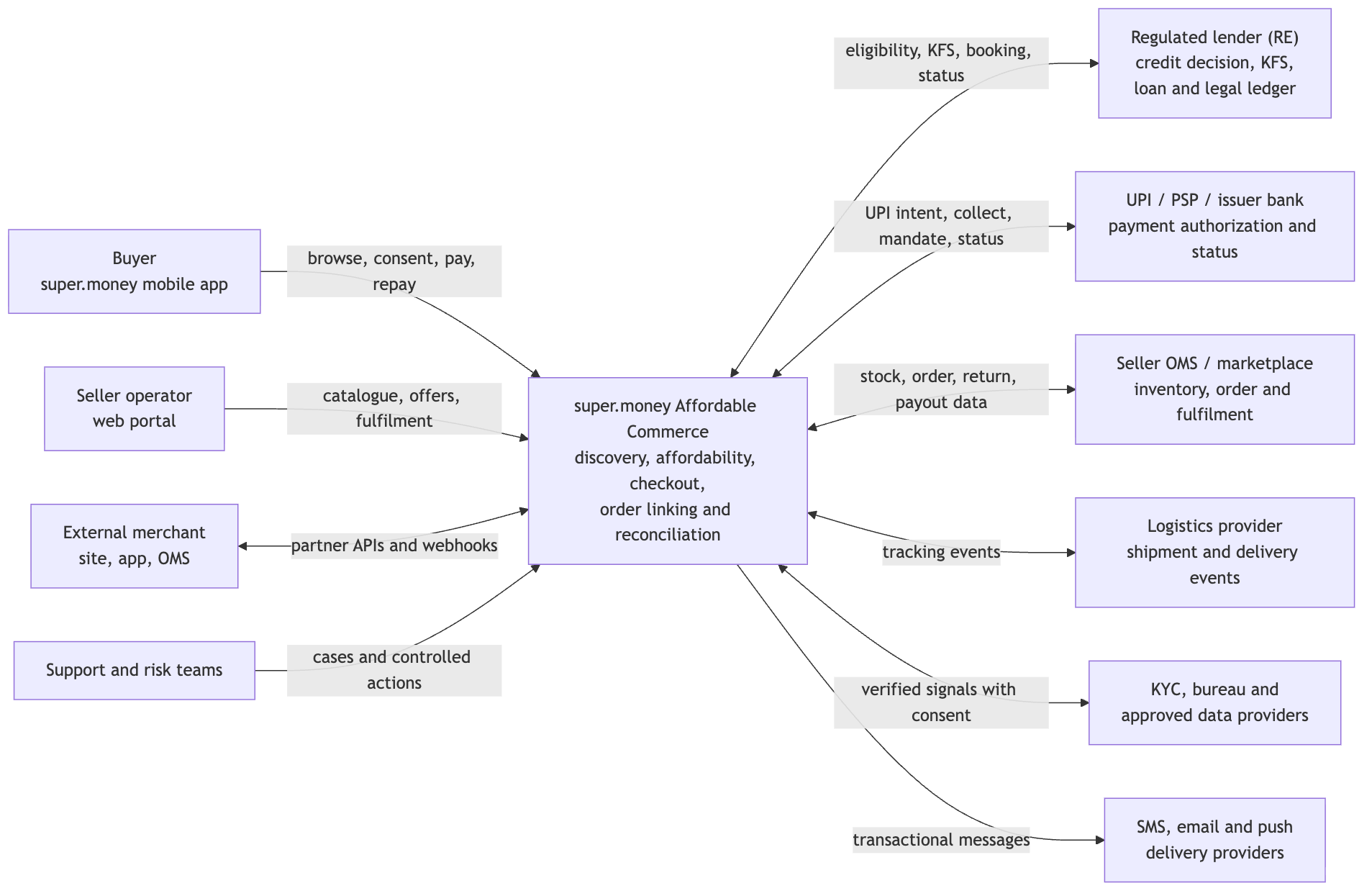
The app owns experience and orchestration. Regulated lenders own credit approval and the loan account. Sellers own catalogue truth and fulfilment.
Catalogue owns product truth, the lender owns the loan, payments own transaction truth, and the order bridge owns fulfilment state.
Every confirmation has a stable key, recorded steps, bounded retries, and compensation when a downstream action fails.
Lender, bureau, payment, and merchant-specific fields stay inside adapters while internal contracts remain stable.
Immutable audit facts, versioned disclosures, ledger-style settlement entries, and reconciliation jobs support investigation.
07 · Launch
30 buyer interviews, 15 merchant interviews, category scoring, baseline funnel, economics, and risk boundaries.
Exit evidence: Signed cohort, category, and contribution model.Tested journeys, disclosures, seller onboarding, APIs, schemas, events, instrumentation, and partner simulators.
Exit evidence: Approved MVP, compliance, and integration contracts.Catalogue, discovery, eligibility, offers, bag repricing, lender adapter, and payment adapter.
Exit evidence: Financeable catalogue and simulated eligible journeys.Checkout saga, orders, repayments, refunds, settlements, support timeline, and reconciliation.
Exit evidence: End-to-end order and matched full/partial refunds.1,000 invited users, three anchor sellers, 100-300 SKUs, one primary credit plan plus full UPI.
Exit evidence: Funnel, risk, and operations within agreed thresholds.Up to 50,000 eligible users, experiment holdouts, daily risk review, and weekly P&L review.
Exit evidence: Positive cohort contribution with repeat and risk signals.Primary: PDP-to-bag · Guardrail: ineligible impressions
Primary: contribution-positive AOV · Guardrail: 30+ DPD
Primary: contribution-positive orders · Guardrail: loss
Primary: incremental orders · Guardrail: seller ROI
The product thesis